Jean McConville
Say NothingJean McConville was a widowed mother of ten in Belfast whose abduction by the Irish Republican Army in 1972 became one of the most consequential cases among Northern Ireland’s Disappeared. Her disappearance did more than remove a mother from her children’s lives: it left them waiting for her return, exposed them to years of uncertainty and public suspicion, and made the allegation that she had been an informer part of a long-running dispute over what had happened to her. A 2006 investigation found no record that she had ever been an agent and concluded that she was innocent; her remains had been found three years earlier, after a search that itself renewed the family’s distress.
Family and circumstances
McConville was thirty-eight when she disappeared. She had given birth to fourteen children and lost four, leaving ten children whose ages ranged from twenty-year-old Anne to the six-year-old twins, Billy McConville and Jim McConville. In 1972 Belfast, large families were common, but caring for ten children was still an immense responsibility. Her family’s size also shaped the consequences of her disappearance: the children were not only grieving a missing mother but were left to manage daily life without her.
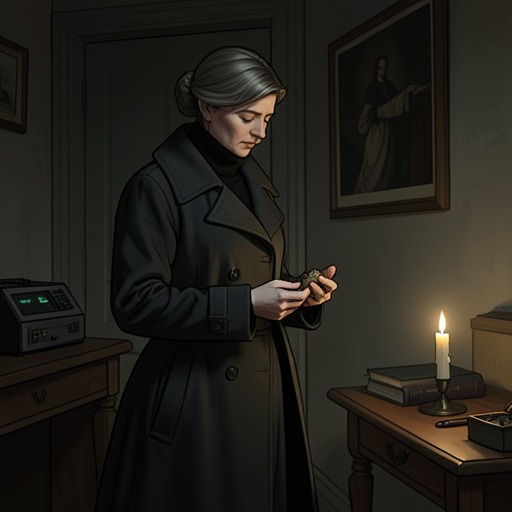
A surviving photograph, taken outside the family home in East Belfast in the mid-1960s, preserves a small, ordinary image of the family before the later crisis. McConville stands beside three of her children, while her husband, Arthur McConville, crouches in the foreground. She faces the camera with her arms folded and a sun-squinting smile. Her children remembered another detail of her appearance: a blue nappy pin fastened to her clothes, useful because one child was always missing a button or needed a repair. The pin became an especially intimate trace of a mother whose life had been organized around the practical work of caring for her family.
By the time she disappeared, the family had experienced displacement and loss. Arthur had died, and McConville had suffered depression, been admitted to Purdysburn, and made suicide attempts, as the book’s account of her life records. She had also helped a wounded British soldier, an act that later became part of the children’s explanation for the hostility directed at her in their nationalist Catholic neighbourhood. As the Troubles intensified, the family’s circumstances were shaped both by bereavement and by the danger of being identified with the other side.
Disappearance and the children left behind
In the period before her disappearance, McConville’s only regular indulgence was going to bingo at a local social club. The city was far from festive: bomb damage had left shops boarded up or closed. When she won, she gave each child twenty pence, and sometimes her winnings bought one of them a new pair of shoes. One evening, after the family had moved into a new flat, she went to bingo with a friend and did not come home.
The children recalled a sequence in which McConville was beaten and questioned after being taken from the bingo hall, then found wandering in a daze and brought home by the army. They believed she was abducted the following evening, on 7 December 1972, while still bearing bruises. Their account could not establish the date with certainty, and the absence of reliable official records would later make the timeline a point of disagreement. The abduction itself was sudden and frightening: roughly eight people, though the children could not rule out ten or twelve, burst into the home. Men and women were among them; some wore balaclavas, others nylon stockings over their faces, and at least one carried a gun.
For weeks, the children stayed together in the family home because they believed their mother might return. A social worker visited after authorities received a call about siblings caring for themselves. The resulting file described their mother as apparently abducted by an organization. The worker spoke to Granny McConville, who considered Helen McConville capable of managing the children; the notes also recorded that there was little affection between Helen and her grandmother. When the authorities eventually took the children into care, Helen loaded her younger siblings into two cars and promised they were going away only until their mother came back. Neighbours watched from the concrete balconies at Divis Flats as the children left.
The uncertainty was sustained by small, stark signs that McConville was unlikely to return. About a week after the abduction, an unknown young man delivered her purse and three rings: her engagement ring, her wedding ring, and an eternity ring given to her by Arthur. He said he knew nothing about her and had only been told to deliver the items. Meanwhile, the children continued to hope that their mother might reappear. Michael McConville, eleven years old, was later questioned by police after he and his brothers stole biscuits; he said they had not eaten for several days. When the authorities asked about their parents, Jim McConville said that his father was dead and the Irish Republican Army had taken his mother away.
Public search and disputed allegations
The disappearance entered public view in January 1973, when a BBC television crew came to St Jude’s Walk looking for the children. The Northern Ireland Civil Rights Association newsletter had already asked where McConville was, reporting that the widowed mother of ten had been removed from her home on 7 December. The Belfast Telegraph followed with a brief article describing a mother missing for a month and noting that none of the children had reported the abduction to police. The next day it appealed for help with what it called a mystery disappearance. The family’s silence was thus made a public detail, even as the children were living with the consequences of the crime and the hope that their mother was still alive.
Years later, the family continued to reject the suggestion that McConville had informed for the British Army. The Irish Republican Army acknowledged responsibility for her disappearance to Helen, then stated in 1999 that McConville had admitted being an informer. Her children disputed that claim and argued that she had been targeted as a Protestant widow in a Catholic nationalist area during intense sectarian tension. They repeatedly recounted that she had tended to a wounded British soldier in Divis Flats and that the words BRIT LOVER were painted on their door. The allegation of informing therefore did not remain an abstract question about intelligence: it became a public accusation that the family believed had compounded the harm done to their mother and to them.
In 2006, Northern Ireland’s Police Ombudsman, Nuala O’Loan, reported that the authorities had never conducted a proper investigation into the abduction. Intelligence files contained rumours that McConville had been abducted because she was an informer, but O’Loan found no military or police records mentioning her before she disappeared and no evidence that she had worked as an agent in Divis Flats. Although the United Kingdom generally neither confirms nor denies whether individuals served as clandestine agents, O’Loan emphasized the exceptional damage the allegation had caused to this family. She stated that McConville was not recorded as an agent at any time and concluded that she was an innocent woman who had been abducted and murdered.
O’Loan’s review also complicated the remembered chronology. The children had thought the beating and questioning occurred one evening and that McConville was taken away the next. An old police log recorded a woman named Mary McConville, with the St Jude’s Walk address, found wandering in West Belfast at 11 p.m. after being beaten. The log said that men had accosted her and warned her to stop giving information to the military. The record appeared to identify Jean, despite the different first name, and to place the warning on the night she was taken from the bingo hall. It did not erase the family’s account of her subsequent return and abduction; rather, it revealed how uncertain and difficult to reconstruct the sequence remained.
Recovery and legacy
The search for McConville’s remains brought the family back to the Cooley Peninsula. Excavators worked for fifty days, opening a crater as large as an Olympic swimming pool. Her children returned to the shore each day, hoping for any clue: a button, a bone, a slipper, or the blue nappy pin they associated with her. At times they watched from a car as evening fell over the Irish Sea. The search was eventually called off because the coordinates supplied for the grave appeared to be wrong. The failed effort made the family’s dependence on information from the organization responsible for the disappearance another source of injury.
In 2003, McConville’s body was found, thirty-one years after she vanished. At a later inquest, Archie McConville spoke of the mother who had cared for the family and the devastation of her absence. Her recovery ended the question of whether she was dead, but it could not restore the missing years or resolve every dispute surrounding the killing. The case remained open as a criminal matter, while the family continued to live with the consequences of the disappearance.
McConville’s daughter Helen spoke at a press conference at the Linen Hall Library after an organization had been formed to address the fate of people abducted and murdered during the Troubles whose bodies had never been found. Wearing the campaign’s sky-blue ribbons, Helen described the people who had come into the family home and taken her mother, and asked how the women involved could face their own children without feeling guilt. Her appeal shifted attention from the mechanics of disappearance to its intimate aftermath: children left to wait, then forced to grow up without knowing where their mother was or why she had been taken. McConville’s story endures both as a case of abduction and murder and as a record of how an unresolved disappearance can keep violence present in a family long after the victim is gone.